What Is a Sidecar Motorcycle? How the Three-Wheeler Works
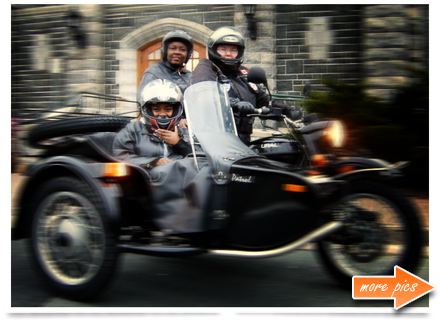
A sidecar motorcycle is a motorcycle with a one-wheeled passenger or cargo car bolted to its side, forming a three-wheeled vehicle often called a rig. The sidecar is rigidly attached at several points, so the whole machine stays upright by itself and does not lean in corners. That changes how it steers, brakes and accelerates compared with a solo bike.
Below is how the parts fit together, why a rig behaves as it does, and what to understand before riding or travelling in one.
The basic parts
A sidecar rig has three main elements:
- The motorcycle. Almost any motorcycle can be fitted with a sidecar, but frames, brakes and suspension differ in how well they cope with the extra load. Heavier, sturdier machines are more common.
- The sidecar (the “chair” or “car”). A small body with a seat, built on its own frame and often with its own wheel and suspension. Some carry luggage instead of a passenger.
- The mounting. Usually three or four connection points join chair to motorcycle. Their adjustment sets the geometry of the rig and is critical to handling.
Most countries drive on the right and fit the sidecar on the right side of the bike. In left-hand traffic countries it is fitted on the left. Some national rules govern how a sidecar must be attached, so local regulations apply.
Why a rig does not lean
A solo motorcycle turns by leaning. A sidecar rig cannot, because it rests on three wheels. To turn, you steer the handlebars much like a car’s steering wheel. At speed, the rig behaves differently depending on whether the turn is toward the sidecar or away from it.
- Turning toward the sidecar (a right turn on a right-hand rig), weight shifts outward, away from the chair. Take it too fast and the sidecar wheel can lift off the ground.
- Turning away from the sidecar, weight shifts onto the chair, which keeps it planted but makes the rig feel heavy and slow to turn, and can lighten the motorcycle’s wheels.
New riders learn to slow down before corners and to feel the weight shift through the bars.
Acceleration and braking effects
Because the driven rear wheel sits to one side of the rig’s centre of mass, power and braking apply force off-centre. On a rig with the sidecar on the right, accelerating tends to pull the rig toward the sidecar, and braking tends to pull it away. Alignment is set up, with a slight toe-in on the wheels and a small lean-out of the motorcycle, to counter this, so a well-adjusted rig tracks straight.
Some rigs are fitted with a brake on the sidecar wheel, and some have a driven sidecar wheel. The latter is known as a two-wheel-drive rig and improves traction in mud or snow.
Steering and the learning curve
People who ride solo usually need practice before riding a sidecar. The main differences:
- You steer actively, instead of leaning.
- Cornering speed matters far more.
- The width of the rig changes how you position it in a lane or on a narrow road.
- Counter-steering, pushing the bar in the direction of the turn at speed, no longer works the same way.
- Parking and low-speed manoeuvres need space.
Training is available in many places, and some jurisdictions have separate licence rules for sidecar riders. Check the transport authority where you live for the current requirements.
What sidecars are used for
Historically, sidecars carried families before small cars became cheap. Military forces also used them in the early and mid twentieth century. Today they are used for:
- Touring, with luggage space or a passenger
- Carrying a dog or cargo
- Accessibility, since a rig can be ridden by someone who has difficulty balancing a two-wheeler
- Leisure and collecting, including vintage rigs
The Ural brand, which originated at the Irbit factory in Russia, is among the best-known makers of new sidecar motorcycles, and its models derive from a German design of the late 1930s. The Ural sidecar page on this site has more detail about the make.
Riding comfort and passengers
A passenger in the chair sits low and close to the road, with a different view from a pillion seat. Chairs may have a windscreen, tonneau cover or seatbelt. Most are built for one adult or a child, though design varies. The sidecar passenger does not need to balance or lean, so people who would not ride pillion can still travel.
Riders should note that a rig is wider than a solo bike and does not “lane-split” or filter through traffic as easily. Road camber, the slope from the centre of the road to the edge, can also tug a rig toward the kerb, and the rider learns to correct for it.
Frequently asked questions
Do you need a special licence for a sidecar?
It depends on the place. Some jurisdictions treat sidecar rigs under a standard motorcycle licence, while others have separate classes or restrictions. Confirm with the licensing authority.
Is a sidecar harder to ride than a motorcycle?
It is different, not necessarily harder. The skills of balance are replaced by steering, and new riders usually need practice, especially for cornering.
Can any motorcycle take a sidecar?
Not every model suits it. Frame strength, brakes and gearing should be checked, and the fitting has to be done by someone who knows the geometry.
Are sidecars safe?
Safety depends on speed, set-up and rider skill. A rig cannot fall over at a standstill, but it behaves differently in turns and in emergency braking.
More general questions are answered in the sidecar FAQ, and the home page introduces the topic of touring Nova Scotia.